How it works

Known question? Measure it. Don’t know the field? Map it.

MVM offers two ways to work. Choose Precision when you already know what you need measured. Choose Adaptive when part of the job is discovering what matters.

More confidence in the same question is not the same as learning more.

“Is the sky blue?”

  • 1Ask onceAn answer
  • 10Ask ten timesStronger confidence
  • 1,000Ask 1,000 timesExtremely strong confidence

Adaptive discovery asks

  • Is the sky blue at 2 a.m.?
  • Was the sky blue last Tuesday?
  • Is the sky blue in downtown Hyderabad?

Expansion is earned by observed evidence, not by mention.

Sampling reduces uncertainty inside a frame. Adaptive discovery also tests whether the frame is complete.

Precision

Known questions. Fixed frame.

  • You define the questions or prompt set.
  • Repeatable sampling across the AI surfaces you select.
  • Presence, recurrence and share, position, cited versus retrieved sources, provider differences, change over time.
  • Fixed scope: economical and highly comparable.

Precision, in detail
Adaptive Field Mapping

Business problem. Evolving field.

  • You supply the business problem and starting context.
  • Begins sparsely; answers show what deserves investigation next.
  • Stable paths close. Material uncertainty or earned adjacency receives more observation.
  • Produces the territory map and the measurement.
Adaptive, in detail

A mature BI team may already know the questions; Precision can be the smarter buy. Adaptive is for the discovery problem.

The Method step of experiment intake: two radio buttons, Precision Measurement (simple sample or frozen question panel) and Adaptive Discovery (iterates prompt wording over generations), with Precision selected.
The first choice in intake. Everything after it follows the method you pick.
Precision

Measure a defined frame.

Precision starts with your questions. Define the questions, market or audience context and the AI surfaces you want measured. MVM samples that frame consistently and reports what was actually observed.

Depending on the selected measurement, the report can show brand presence, recurrence or share, textual position, the sources each answer actually cites as distinct from the wider set of sources the surface retrieved, differences across AI surfaces, and the evidence behind the measurement.

Precision is intentionally bounded. That makes it highly comparable, repeatable and economical. If your business intelligence team already knows the questions it wants answered, Precision may be the smarter buy.

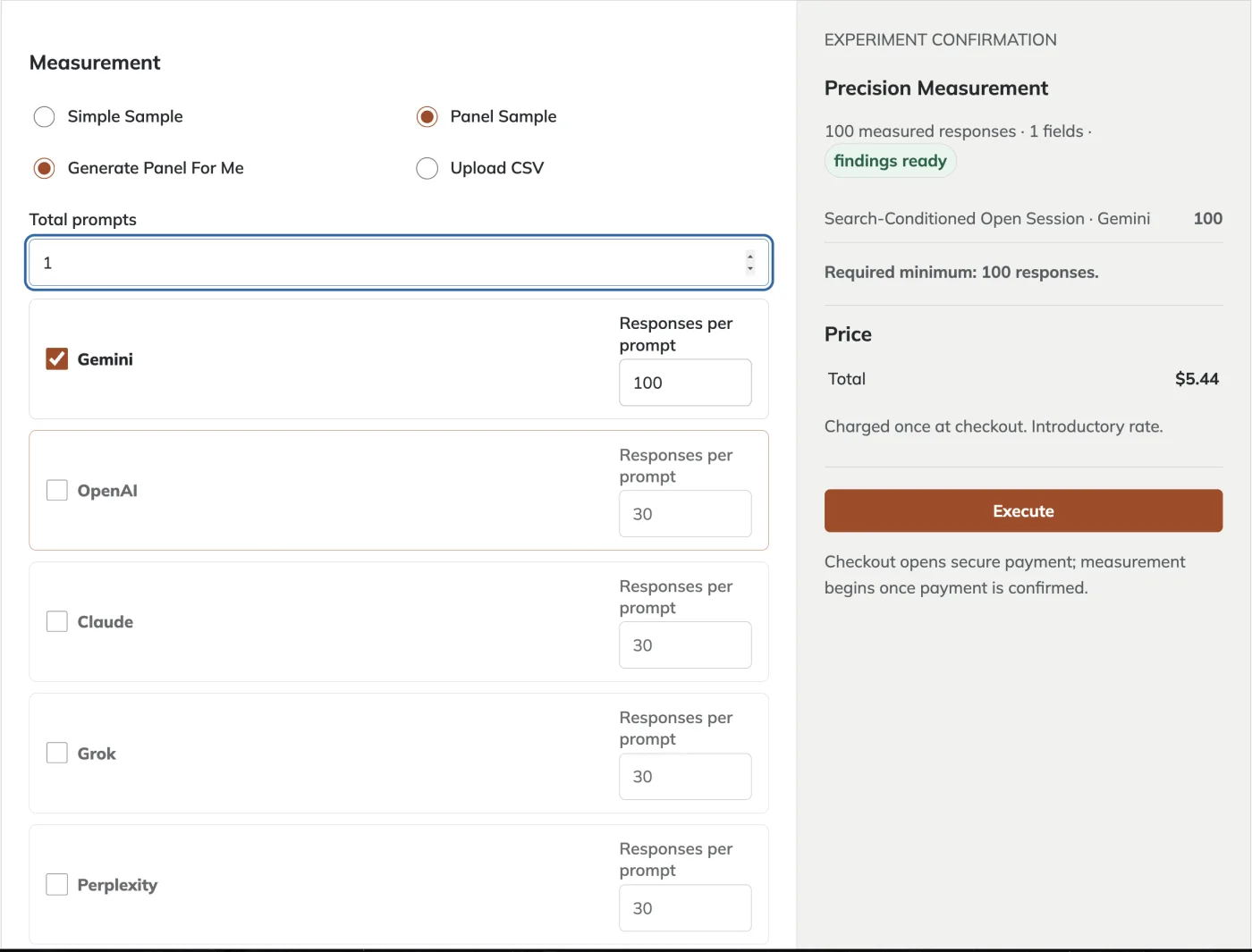
Precision intake: Panel Sample with Generate Panel For Me selected, one total prompt, Gemini checked at 100 responses per prompt, and the confirmation panel showing 100 measured responses, findings ready, required minimum 100 responses and a total price of $5.44 at the introductory rate of the time.
A Precision setup: one generated panel, one model, 100 responses. The price is shown before anything runs; this figure shows an earlier introductory rate, and the same setup quotes about $5 today.
Adaptive Field Mapping

Spend the next observation where it can still change the answer.

Adaptive starts from the business problem, the client or product context and a sparse set of starting questions. Those questions establish the commercial ground state; they do not define the entire universe in advance. Explore the commercial surface directly with open-session prompts where available (useful at Gemini for instance), or simulate user profile dimensions to test account-level variance among different prompt intent signals.

  1. Start

    • Buyer reality
    • Client or product context
    • Sparse starting questions
  2. Observe

    • Brands
    • Contexts and use cases
    • Geography and locality
    • Sources
    • Meaningful absence
  3. Decide

    • Enough evidence: stabilize
    • Material uncertainty: observe again
    • Earned adjacency: expand
  4. Field

    • Recurring territory
    • Market structure
    • Gaps and uncertainty
    • Opportunity
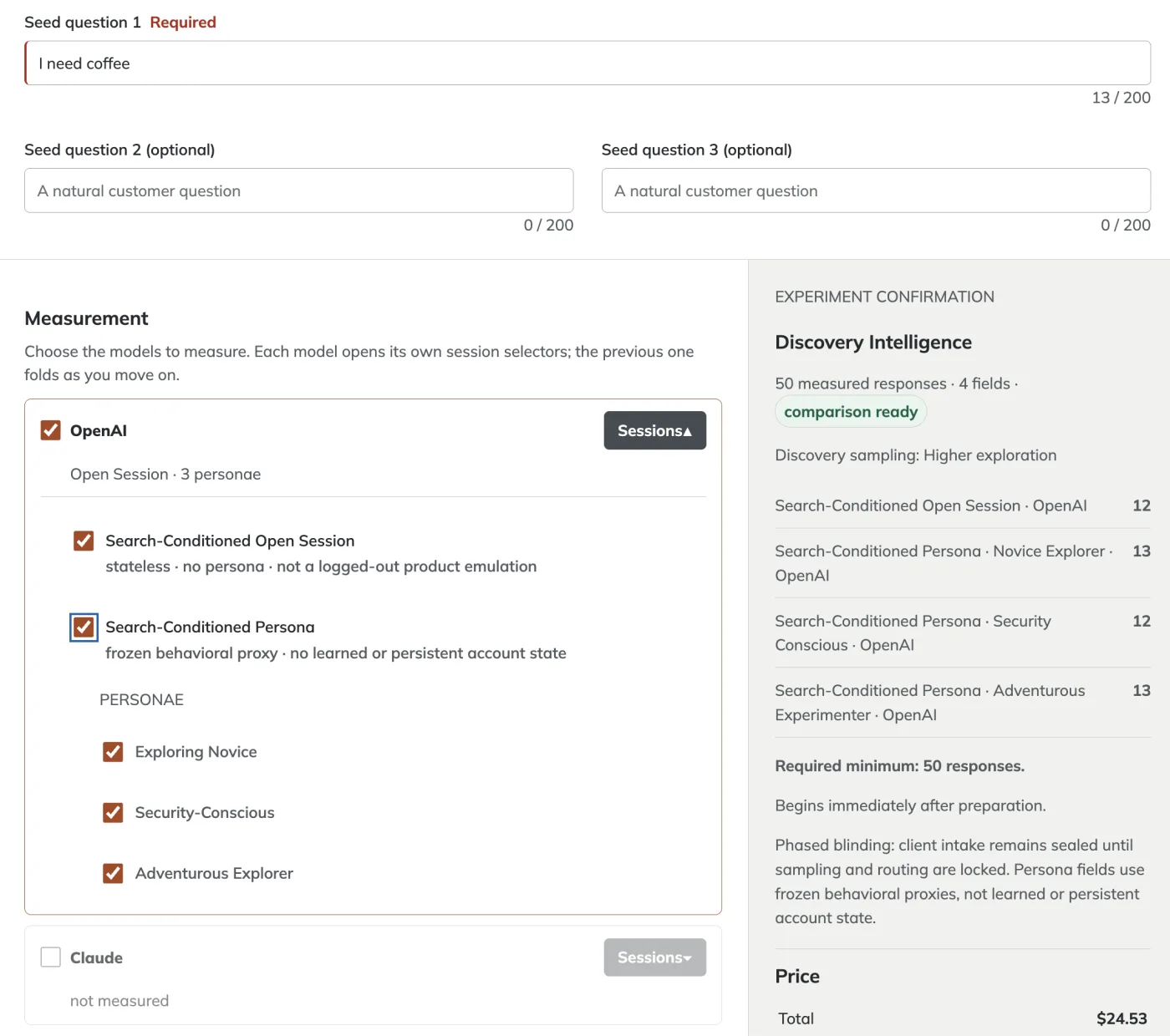
Adaptive intake: seed question one reads I need coffee, two optional seed questions are empty; under Measurement, OpenAI is checked with a Search-Conditioned Open Session and a Search-Conditioned Persona using three personae (Exploring Novice, Security-Conscious, Adventurous Explorer); the confirmation panel shows Discovery Intelligence, 50 measured responses across 4 fields, comparison ready, higher exploration sampling, required minimum 50 responses and a total price of $24.53, as the intake stood at the time.
An Adaptive setup: one seed question, one model, four sessions. The field grows from here only where evidence earns it. This figure predates the current intake floor: a four-field Adaptive run now requires at least 100 responses, and the price shown at intake is always the current one.
How we measure

No browser surveillance. No harvesting others’ chat conversations. Transparent methodology.

Each prompt and response is a unique measurement at AI surfaces. Minimum Viable Metric does not scrape, aggregate, or otherwise collate any prior data in constructing your report. What you see is what the LLMs returned “right then” for each of your prompts. Each experiment always gets unique and fresh results for your queries.

Richer data. More actionable intelligence.

We use LLM APIs to measure how brands appear in AI-generated responses. This means we don’t rely on scraping technology or “other people’s traffic” to get our reported results. MVM has invested considerable effort in testing and refining our methodology to closely approximate what consumers see at tools like ChatGPT, Gemini, and Claude. It’s true that no measurement can perfectly reproduce every individual’s AI experience. However, our approach provides something especially valuable: a much richer view of the information ecosystem behind those answers.

Alongside brand visibility measurements, we analyze available citations, source relationships, competing brands, and recurring patterns that help reveal what makes businesses discoverable to AI. We do this through controlled, repeatable sampling, not uninvited monitoring of people’s browsing activity. We aren’t just counting mentions. Our goal is to give you the evidence and competitive intelligence to understand your site’s visibility in an actionable context.

Top 3 brand mentions by provider

The three businesses that led each answer, per AI surface and sampled location.

Both reports open with the comparable part of the consumer’s answer; the full list and the sources follow.

The opening section reads each answer as a consumer would and keeps the first three businesses it named, recommendations first and then other businesses present, ranked across responses by how often they led. Your brand is always shown with its own position, even when it falls outside the top three, and anything an answer cautioned against is listed separately. Every business named, in full, appears in the sections that follow.

Sources are reported separately. A cited source is one the answer itself points to: a link anchored in the text the consumer reads. A retrieved source is a page the surface fetched while building the answer but did not necessarily show. The citation index and source-coverage sections keep the two apart and never pool them, and they say which kind of evidence each provider exposes, so a thin citation table is read as a property of the provider, not of your brand.

Brand presence and citations are distinct measurements. A business can be named in an answer without any source being cited, and a source can be cited without naming anyone. The report shows both, in their own places.

Search Tandem

Conventional search, observed alongside, never mixed in.

An optional companion measurement for either product.

When enabled, each question in your experiment is also observed on conventional search surfaces at the same time the AI surfaces are measured: Google Search always, and optionally Maps, Shopping, Bing, YouTube and others. You see what a searcher would have seen next to what an AI user was told.

Search Tandem is independent by design. Its observations never feed the AI measurement, the AI measurement never changes them, and the two are reported side by side rather than combined. It is priced separately, once per question per surface, and included in the single quote shown before launch; leave it off and nothing is added.

From answers to action

Turn AI answers into a strategy queue.

Both services are designed to end in action rather than dashboard accumulation.

  1. Listen

    Begin with real customer questions and business priorities.

  2. Map

    Expose the territories the answer field makes visible.

  3. Test

    Turn the strongest territories into content, media, audience, product or experience hypotheses.

  4. Remap

    Measure what strengthened, held, faded or newly appeared after intervention.

What you receive

Measurement. Discovery. Action.

Measurement

What was observed: presence, share, surface differences, cited and retrieved sources, and the confidence behind each.

Discovery

What else deserves attention: recurring contexts, localities, sources and meaningful absences.

Action

A queue your team can use. Reports preserve the evidence behind the conclusion, and completed reports and CSV exports are archived to your account.

Ready to start?

Build an experiment in your account, or ask us about a custom one.